
This post may contain affiliate links. We earn commissions when you shop through the links below at no additional cost to you.
The commissions we receive help continue to run this site.
Affiliate Disclosure
Let’s start with some truths about mythology: Most of the stories we know about gods, monsters, heroes, and the occasional mythological women who dared to have opinions, were written down by men.
Not always originally told by men. Many myths began as oral traditions passed through generations of storytellers. But the versions that survived, the ones preserved in epics, scrolls, and historical texts, were overwhelmingly recorded by male poets, historians, and scribes. That means the stories we inherited were often filtered through the values and anxieties of societies that were not exactly thrilled about women wielding power.
And when that lens shaped the narrative, something very predictable began to happen to mythological women.
They became villains.
Or monsters.
We cannot possibly forget about seductresses.
And, my favorite!, cautionary tales about what happens when women get a little too ambitious.
Throughout these stories, sometimes they were punished. Sometimes they were sexualized. Sometimes they were literally transformed into monsters for the crime of existing outside the boundaries men preferred. And sometimes, perhaps the most efficient storytelling trick of all, they were simply erased.
Welcome to the complicated and fascinating world of feminist mythology, where revisiting ancient stories often reveals just as much about patriarchal fear as it does about the myths themselves.
Because mythology does more than entertain us. It quietly shapes cultural ideas about power, morality, leadership, and gender. When generation after generation grows up hearing stories where powerful men are heroic but powerful women are dangerous, manipulative, or destructive, those patterns do not stay locked inside ancient texts. They seep into the way societies think about authority, influence, and who is allowed to hold power.
But myths were never meant to be frozen in time.
Stories evolve. They shift. And when we revisit them through new perspectives, we start to notice the cracks in the narrative. The villain might not be a villain at all. The monster might actually be a survivor. Our so-called temptress? She might simply be a woman refusing to accept the role someone else wrote for her.
Reclaiming mythological women is not about rewriting the past. It is about recognizing that many of these figures were filtered through centuries of storytelling shaped by patriarchal systems that feared women with power far more than they understood them.
And once you start looking at mythology through that lens, the stories become far more interesting.
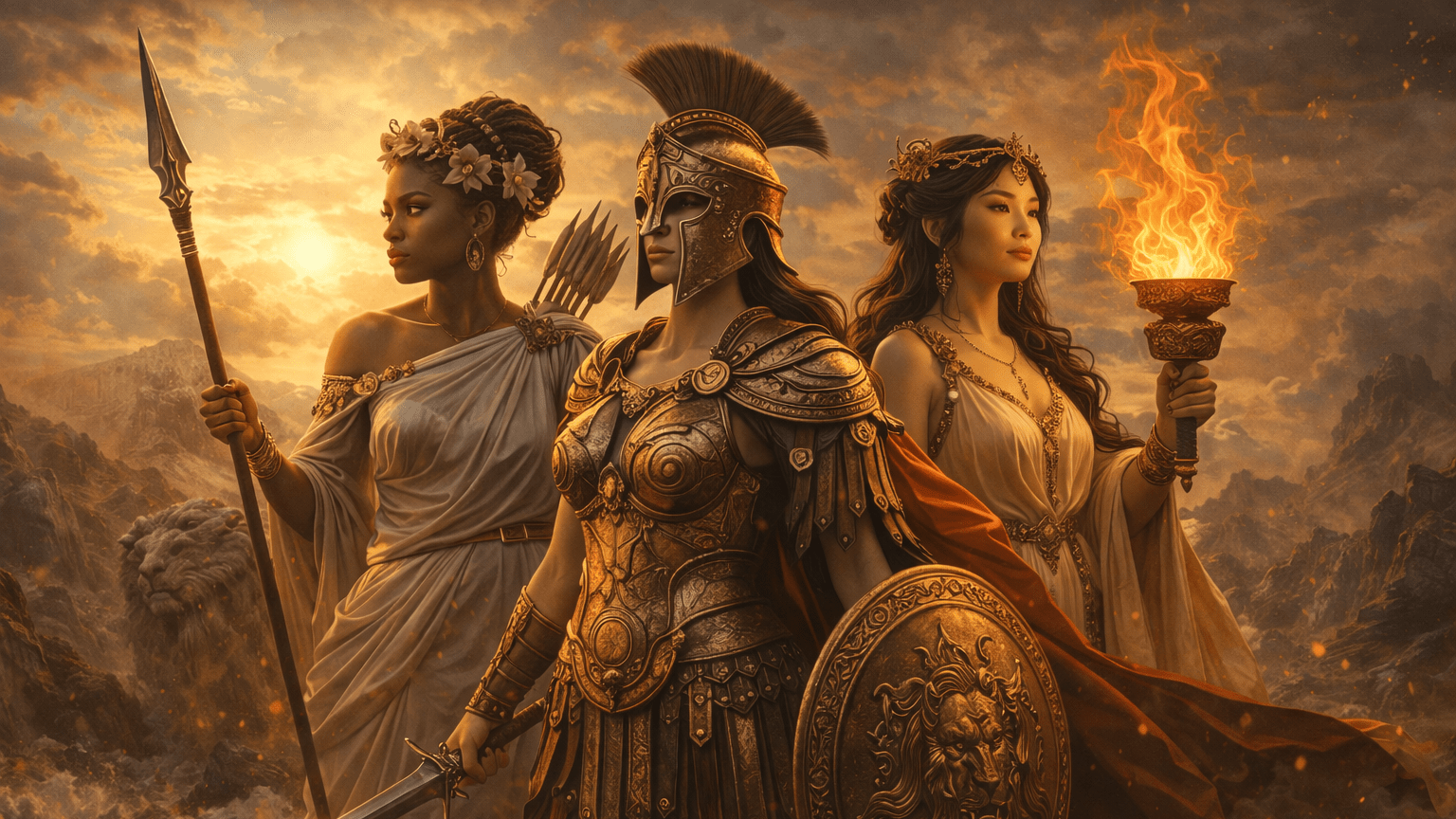
Across cultures, from Greek legends to African folklore, from Asian mythologies to Indigenous storytelling traditions, mythological women appear again and again as warriors, creators, tricksters, rulers, healers, destroyers, and forces of nature in their own right.
These women were never weak.
They were never silent.
They were simply written about by people who were not always comfortable with what powerful women represented.
So in this post, we are going to revisit some of those stories.
We will explore the mythological women who were demonized, misunderstood, or deliberately diminished, and the growing movement in feminist mythology that is reclaiming their complexity, their power, and their rightful place in the story.
Because frankly, they deserved better.
- What Does It Mean To Reclaim Mythological Women?
- When Powerful Mythological Women Became Villains
- The Archetypes of Mythological Women
- Why These Stories Still Matter Today (Especially Because They’re Drowning in Misogyny)
- Modern Writers Reclaiming Mythological Women
- Reclaiming Myth Is an Act of Storytelling Power
What Does It Mean To Reclaim Mythological Women?
Reclaiming mythological women does not mean rewriting ancient stories so that every character suddenly behaves like a modern feminist icon who runs a leadership seminar and communicates exclusively through empowering quotes.
That would be… a very different genre of mythology.
Reclaiming mythological women is something much more interesting than rewriting the past. It is about reexamining the stories we inherited and asking a very simple question.
Who told this story, and why does this woman end up being the villain?
Because once you start looking closely at myths through that lens, you begin to notice a pattern. Powerful women in mythology were often portrayed as dangerous, manipulative, irrational, seductive, monstrous, or some thrilling combination of all five. Meanwhile, the male characters around them were usually framed as heroes, kings, warriors, or tragic figures who were simply having a rough week.
Suspicious.
Reclaiming mythological women means separating the original cultural story from the layers of interpretation that were added later. It means looking at myths through modern lenses that allow us to question narratives that once went completely unchallenged. And it means recognizing that many female figures in mythology were not written to be complex people. They were written to serve as warnings.
Warnings about what happens when women refuse to behave.
Take Medusa, one of the most famous mythological women in Greek mythology. For centuries she has been remembered primarily as a monster whose gaze turns people to stone. That is the version most people recognize. But earlier versions of the myth tell a more complicated story. Medusa was once a woman who was assaulted in a temple and then punished by the goddess Athena, transforming her into the creature we now recognize. The villain in that story starts to look very different depending on where you place the moral lens.
Then there is Lilith, a figure from ancient Jewish folklore who has been painted as a demon for centuries. According to some traditions, Lilith refused to submit to Adam and left the Garden of Eden rather than accept a subordinate role. The result was that later interpretations transformed her into a child-stealing night demon. Because apparently refusing patriarchy was enough to earn a very dramatic rebrand.
Another fascinating example comes from Chinese mythology with Chang’e, the moon goddess. In some versions of her story she is portrayed as selfish or reckless for drinking an immortality potion meant for her husband. In other interpretations, she is a woman making an impossible choice in a complicated situation, one that ultimately leaves her isolated on the moon. The difference between those interpretations says far more about the storyteller than it does about Chang’e herself.
Reclaiming mythological women means revisiting these stories and restoring the complexity that was often stripped away over time. Women in mythology were not simply monsters, temptresses, or moral warnings. They were leaders, strategists, rebels, creators, lovers, protectors, destroyers, and sometimes deeply flawed individuals navigating worlds that were not designed for their autonomy.
In other words, they were people.
Complex people. Contradictory people. Powerful people.
Shocking, I know.
And once we allow mythological women to reclaim that complexity, the stories themselves become far richer than the simplified versions many of us grew up with.
When Powerful Mythological Women Became Villains
Mythology has a fascinating habit of turning powerful women into problems.
Across cultures, storytellers introduced formidable mythological women who possessed intelligence, magic, political influence, or divine authority. Then the narrative took a sharp turn and labeled those same women dangerous, immoral, manipulative, or outright monstrous.
Coincidence? Not likely.
When societies felt uneasy about women holding power, the stories often reflected that anxiety. Instead of celebrating female strength, many myths framed powerful women as threats that heroes needed to defeat, control, or punish. In other words, the story quietly reinforced a message about who should and should not wield power.
Let’s look at a few mythological women who received the villain treatment.
Circe: The Sorceress Who Refused to Behave
Greek mythology introduces Circe as a powerful sorceress who lives alone on the island of Aeaea. She masters magic, commands the natural world, and runs her own household without any male supervision.
Naturally, the story decides that this independence must be suspicious.
When Odysseus and his crew arrive on her island in The Odyssey, Circe turns several of his men into pigs. Later retellings love to frame her as a manipulative temptress or a dangerous witch who preys on unsuspecting sailors.
But look at the situation from another angle.
A group of armed strangers shows up on her island. They enter her home. They behave badly. Circe defends herself using the tools she has. Frankly, turning them into pigs feels like a fairly restrained response.
Circe stands as one of many mythological women whose intelligence and autonomy made storytellers uncomfortable enough to cast her as a villain.
The Morrígan: Power Misunderstood
In Irish mythology, The Morrígan appears as a goddess associated with war, prophecy, and sovereignty. She shapeshifts into animals, influences battles, and warns warriors of their fate.
That kind of power makes her fascinating and intimidating in equal measure.
Later interpretations often portray The Morrígan as a sinister figure who delights in chaos and destruction. But in the original myths, she does far more than simply cause trouble. She protects territory, challenges arrogant heroes, and embodies the harsh realities of warfare.
The Morrígan does not fit neatly into a comforting box of “good” or “evil.” She represents the reality that power, especially power tied to war and fate, carries both creation and destruction within it.
Yet storytellers often simplify complex mythological women into villains because complexity makes people uncomfortable.
Kali: Destruction With a Purpose
In Hindu mythology, the goddess Kali commands enormous cosmic power. She appears fierce, terrifying, and unstoppable as she destroys demons and restores balance to the universe.
Her imagery unsettles many people. Kali often appears with a garland of skulls, dark skin, wild hair, and weapons in her hands. She represents the destructive force necessary to defeat evil and protect the world.
But outside of her cultural context, many observers misunderstand her entirely. Some portray Kali as a chaotic or violent goddess without purpose. That interpretation strips away the deeper meaning behind her role.
Kali destroys demons so life can continue. She fights cosmic imbalance so the world can survive. She does not embody evil; she embodies the terrifying power required to confront it.
Like many mythological women, Kali demonstrates how easily powerful female figures become misunderstood when people view them through the wrong cultural lens.
The Pattern Behind the Villain
These examples reveal a pattern that appears throughout mythology.
When mythological women display intelligence, independence, or supernatural power, the story often reacts by labeling them dangerous. The narrative transforms them into villains, monsters, or cautionary tales about what happens when women step outside the roles society assigned to them.
Reclaiming these figures does not require rewriting mythology. It requires reading the stories with clearer eyes.
When we revisit these myths today, we can recognize what earlier storytellers feared: Powerful women who refused to behave quietly.
The Archetypes of Mythological Women
When you explore the stories of mythological women across cultures, you start to notice something interesting. Even though these stories come from completely different parts of the world, many of them share similar character types.
Mythologies tend to return to a handful of familiar archetypes. These archetypes helped ancient storytellers explain power, creation, danger, wisdom, and the roles women played in their societies.
The problem is not the archetypes themselves. Archetypes help stories travel across time and culture. The problem shows up in how later storytellers flattened those archetypes into stereotypes. A powerful figure becomes a villain. A wise woman becomes a witch. A creator becomes a passive mother figure who quietly fades into the background.
But when you look closely, mythological women rarely fit neatly into a single box. Many of them shift between roles. They create, destroy, guide, protect, and challenge the world around them.
In other words, they behave like fully developed characters instead of one-dimensional symbols.
Let’s look at a few of the archetypes that appear again and again.
The Warrior
The warrior archetype represents strength, strategy, and the willingness to defend a people or a cause. Many cultures feature mythological women who step into battle not as background figures but as powerful forces in their own right.
Take Durga from Hindu mythology. Durga rides into battle on a lion and defeats the buffalo demon Mahishasura after the male gods fail to stop him. She does not assist the heroes. She is the hero.
In Yoruba mythology from West Africa, Oya commands storms, winds, and lightning while guarding the gateway between life and death. She brings change and upheaval, and she refuses to apologize for it. Oya represents transformation in its most powerful form.
These warrior figures challenge the tired idea that strength belongs exclusively to male heroes. Many mythologies place women directly in the center of the battle.
The Creator or Mother
Many traditions feature mythological women who shape the world itself. These figures do not simply nurture life. They create it.
In Andean mythology, the goddess Pachamama embodies the living earth. She sustains crops, mountains, animals, and human life. Communities across the Andes still honor her today because she represents the balance between humanity and the natural world.
In Chinese mythology, Nüwa literally creates humanity. According to legend, she molds the first humans from yellow clay and later repairs the broken sky after a cosmic disaster. She does not merely give birth to humanity. She rebuilds the universe.
These figures remind us that the power to create worlds has always belonged to mythological women, even if later storytellers tried to soften that authority.
The Witch or Sorceress
Few archetypes have suffered more from bad publicity than the witch.
Stories often portray magical mythological women as manipulative, dangerous, or morally suspect. But magic in mythology often represents knowledge, wisdom, and connection to unseen forces.
In Slavic folklore, Baba Yaga appears as a terrifying witch who lives in a hut that walks on chicken legs. She challenges travelers with difficult tasks and impossible questions. Some stories show her helping those who prove brave and clever enough to face her tests.
Baba Yaga does not exist to serve heroes. She forces them to grow.
In Hawaiian mythology, the goddess Pele commands volcanoes and fire. She creates new land through destruction and transformation. Pele acts with passion, anger, and creativity, and her stories reflect the raw power of the natural world.
These magical figures show that many mythological women held deep knowledge of nature, transformation, and spiritual power.
The Trickster
Mythology often reserves trickster roles for male figures, but many cultures include clever mythological women who disrupt order and challenge authority.
In Japanese folklore, the fox spirit Kitsune shapeshifts into human form and uses wit and intelligence to outmaneuver powerful men. Some stories show her as a mischievous prankster. Others portray her as a loyal protector or wise guide.
Kitsune does not follow rules simply because someone expects her to.
The Sovereign or Ruler
Some mythological women do not fight battles or cast spells. They rule.
In ancient Sumerian mythology, the goddess Inanna governs love, war, and political power. She descends into the underworld, negotiates with dangerous forces, and returns stronger than before. Her stories explore ambition, authority, and transformation.
Inanna reminds us that leadership has never belonged to men alone.
Archetypes With Edges
These archetypes do not exist in isolation. A single figure often embodies several at once. A warrior can also create life. A ruler may wield magic. A sorceress may protect the world.
That complexity appears again and again in stories about mythological women. Ancient storytellers understood something that later interpretations sometimes ignored.
Women in myth were never meant to be simple characters.
They were powerful, unpredictable, brilliant, destructive, protective, and endlessly complicated.
Just like the societies that created them.
Why These Stories Still Matter Today (Especially Because They’re Drowning in Misogyny)
It would be very convenient if mythology stayed neatly locked in the past.
Old stories. Ancient cultures. Dusty scrolls. Nothing to do with us anymore.
Unfortunately for that comforting idea, mythology still shapes the stories we tell today. The archetypes, patterns, and character roles created thousands of years ago continue to influence modern storytelling in books, movies, television, and even the way people think about leadership, power, and gender.
Which means the treatment of mythological women in ancient stories still echoes into the present.
Look closely at modern storytelling and you will start to recognize the same patterns that appear in myth. The powerful woman who becomes the villain. The ambitious woman who must be punished. The magical woman who becomes dangerous simply because she exists outside the rules.
These story structures did not appear out of nowhere. They grew out of centuries of mythological tradition where female power often made the storytellers deeply uncomfortable.
Many ancient myths turned mythological women into warnings. The story taught audiences what happens when women step outside their expected roles. If a woman seeks knowledge, she becomes dangerous. A woman who refuses obedience becomes monstrous. A woman who wields power becomes something that must be defeated.
And those patterns stuck.
Modern storytelling still struggles with this legacy. Female characters with ambition often get labeled ruthless. Women with authority become cold or villainous. Meanwhile, male characters with identical traits get framed as strong leaders or misunderstood antiheroes.
The roots of that narrative imbalance run deep, and mythology helped plant them.
That does not mean mythology itself is the enemy. In fact, many ancient traditions already included powerful mythological women who defied those limitations. What matters is how later generations interpreted those stories and which versions they chose to amplify.
When people revisit these myths today, they gain the opportunity to challenge those inherited interpretations.
Readers can question why a woman with power became the villain. Scholars can examine how cultural fears shaped certain narratives. Writers can retell these stories in ways that restore the complexity that earlier interpretations stripped away.
Reexamining mythological women does not erase the past. It expands the conversation about it.
And that matters because stories shape expectations. Stories teach people what power looks like and who deserves to hold it. If every ancient narrative treats female authority as a threat, modern audiences absorb that message whether they realize it or not.
But mythology does not belong to one generation.
These stories have evolved for thousands of years, and they will continue evolving as new voices interpret them. When modern readers reclaim mythological women, they do not rewrite history. They reopen the story and allow long-silenced perspectives to speak again.
Which makes mythology something far more powerful than a collection of ancient tales.
It becomes a conversation that continues across centuries.
Modern Writers Reclaiming Mythological Women
For centuries, storytellers framed many mythological women as monsters, temptresses, or cautionary tales. But modern writers have started pushing back on those narratives in a big way. Over the last few decades, authors have revisited ancient myths and retold them from the perspectives of the women who were often sidelined, misunderstood, or deliberately villainized.
And once those women get to tell their side of the story, things get interesting very quickly.
These retellings do not erase mythology. They dig deeper into it. They ask uncomfortable questions about the original narratives and explore what those stories might look like if the women at their center had agency, voice, and complexity.
If you want to explore modern interpretations of mythological women, these books are an excellent place to start.
Circe by Madeline Miller
Madeline Miller’s Circe takes the infamous Greek sorceress and turns the spotlight directly onto her story. Instead of the manipulative witch described in The Odyssey, Miller presents Circe as a fiercely intelligent and determined woman navigating the dangerous politics of the gods.
The novel explores exile, independence, magic, and survival in a world where the Olympian gods wield enormous power and very little accountability. Circe becomes something far more interesting than a villain. She becomes a fully realized character learning how to define her own strength.
The Penelopiad by Margaret Atwood
In Homer’s Odyssey, Penelope spends most of the story waiting patiently for her husband to return home. Margaret Atwood looked at that narrative and asked a perfectly reasonable question.
What was Penelope actually thinking during those twenty years?
The Penelopiad retells the story of Odysseus from Penelope’s perspective, allowing her to reflect on the chaos surrounding the famous hero’s absence. Atwood also gives voice to the twelve maids who were executed in the original story, raising powerful questions about justice and power in ancient narratives involving mythological women.
A Thousand Ships by Natalie Haynes
The Trojan War has inspired countless retellings, but Natalie Haynes shifts the focus away from the male warriors and toward the women whose lives the war destroys.
A Thousand Ships weaves together the stories of queens, goddesses, mothers, and captives whose voices often disappear in traditional versions of the myth. The novel examines the devastating consequences of war through the experiences of women like Hecuba, Andromache, and Cassandra.
Haynes reminds readers that the epic battles of mythology rarely happen in isolation. They leave enormous human costs behind, especially for the women caught in their path.
Ariadne by Jennifer Saint
In Greek mythology, Ariadne famously helps the hero Theseus defeat the Minotaur by giving him the thread that allows him to escape the labyrinth. Then he promptly abandons her on an island.
Jennifer Saint’s Ariadne explores the story from Ariadne’s perspective and follows both her life and the life of her sister Phaedra. The novel examines betrayal, family loyalty, and the complicated roles women often play in myths where male heroes dominate the narrative.
Saint’s retelling allows these mythological women to reclaim emotional depth and agency that traditional versions rarely explored.
Kaikeyi by Vaishnavi Patel
Drawing from the Hindu epic Ramayana, Vaishnavi Patel’s Kaikeyi revisits one of the story’s most controversial figures. Traditional tellings often portray Queen Kaikeyi as the villain who exiles Prince Rama from the kingdom.
Patel’s retelling takes a closer look at Kaikeyi’s motivations and political struggles, presenting her as a complex ruler navigating palace politics, prophecy, and personal ambition. The novel reframes a character long criticized in mythology and invites readers to reconsider how mythological women become villains in traditional narratives.
Modern retellings like these show just how powerful mythology can be when writers revisit it with fresh perspectives. Instead of flattening mythological women into stereotypes, these authors explore their motivations, intelligence, fears, and ambitions.
The result is not a rejection of myth.
It is a reminder that myths have always evolved, and every generation gets the chance to tell the story a little differently.
Reclaiming Myth Is an Act of Storytelling Power
Stories have always shaped how we see the world.
Who holds the power? They tell us what strength looks like. They tell us who gets remembered as a hero and who gets written off as a warning.
So when we reclaim mythological women, we are not just revisiting old stories. We are actively shifting the narrative.
For centuries, many of these women were filtered through storytelling traditions that did not know what to do with female power unless it could be controlled, softened, or punished. The result gave us generations of myths where women who stepped outside the lines paid for it.
But stories are not fixed.
They never have been.
Mythology has always evolved with the people telling it. Every retelling, every interpretation, every shift in perspective adds another layer to the story. That means we are not passive consumers of myth. We are participants in it.
When we revisit mythological women and question the narratives surrounding them, we reclaim something that was never truly lost. We restore agency, complexity and allow these figures to exist as more than symbols or warnings.
We let them be powerful without immediately labeling that power as dangerous.
And that shift matters.
Because storytelling does not just reflect culture. It helps shape it. The stories we tell influence how we understand leadership, identity, ambition, and who deserves to take up space.
When powerful women appear in stories as complex, capable, and unapologetically themselves, it expands what power can look like in the real world.
It challenges the old narratives that tried to shrink them.
It reminds us that strength has never belonged to one gender.
And perhaps most importantly, it proves that the story is still being written.
The women of mythology were never silent.
They were never finished.
We are simply learning how to listen.And if you’re ready to keep exploring the stories that shaped cultures, beliefs, and the beautifully strange corners of human imagination, you can find more folklore, legends, and mythological deep dives here.